Our Work
Six strategic pillars that turn water stewardship from an idea into work that happens on the ground.
Home / Our Work
Bring This Work to Your Community
Water education, catchment restoration and monitoring — delivered together with the people who live there.
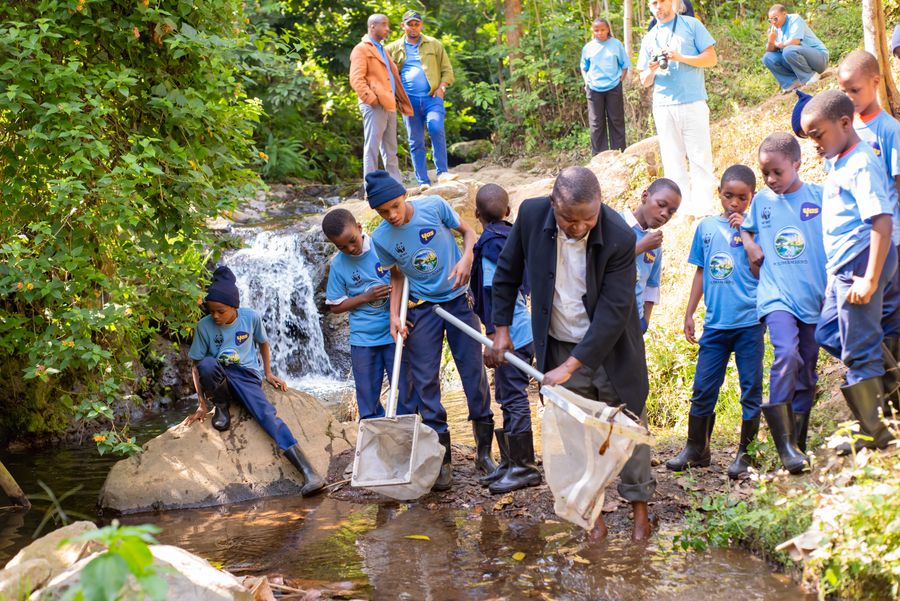
Water Security & Stewardship
KIWI promotes water management practices that improve water availability, efficiency, quality and resilience — for people, for nature and for economic development.
Water security is not only about how much water exists. It is about whether it arrives where it is needed, whether it is clean enough to use, and whether the systems around it can absorb a bad season. We work on all three at once.
What this looks like on the ground
- Protecting springs and water sources from contamination and encroachment
- Water quality sampling and monitoring carried out with local communities
- Promoting efficient water use across households, farms and enterprises
- Building resilience so that dry seasons and shocks do not become crises
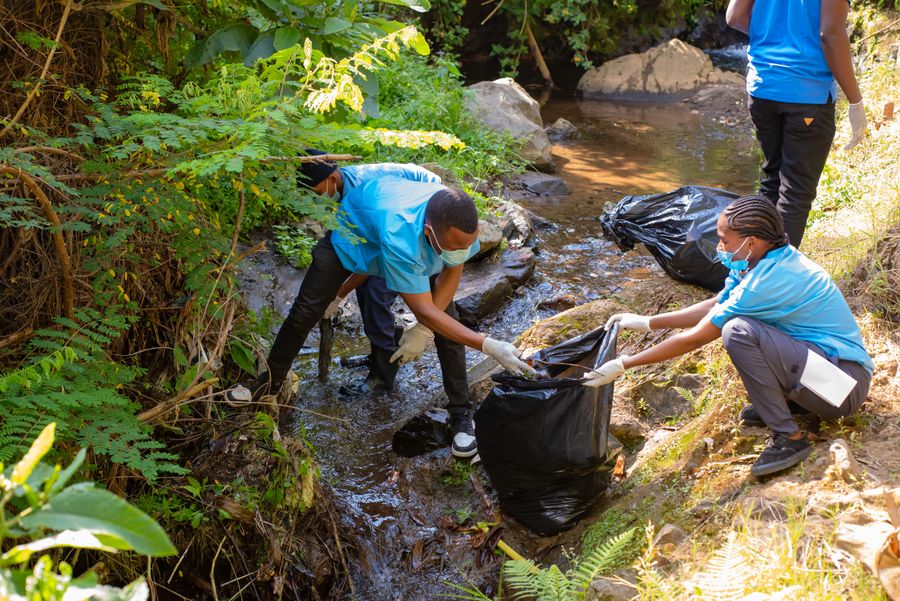
Watershed & Ecosystem Restoration
We restore the forests, rivers, springs, wetlands and catchments that sustain water resources and biodiversity — and we work to keep them healthy.
A watershed is a system. Degrade the forest at the top and the spring at the bottom runs dry. Clog the river with waste and the whole community downstream pays for it. Restoration means treating the landscape as the single connected thing it actually is.
What this looks like on the ground
- River and streambed cleanups run together with schools and communities
- Reforestation and riverbank stabilisation in degraded catchment areas
- Protecting wetlands and springs that regulate flow across the landscape
- Supporting the biodiversity that healthy freshwater systems depend on

Livelihoods & Climate Resilience
KIWI supports communities, farmers and enterprises to improve incomes while adopting sustainable water and land management practices.
Conservation that costs people their livelihood does not last. The work has to pay — in better yields, lower risk, more reliable water, or new income. When sustainable practice is also the practical choice, it holds without anyone policing it.
What this looks like on the ground
- Sustainable water and land management practices for smallholder farmers
- Support for enterprises whose growth depends on secure, clean water
- Climate resilience planning with the communities most exposed to shocks
- Linking improved incomes directly to improved stewardship of the catchment

Collective Action & Partnerships
We build the partnerships that unite communities, government, businesses, academia and development partners around shared water stewardship goals.
This is the pillar the others rest on. Water crosses every boundary — property lines, district borders, sectors, mandates. A response that does not cross those same boundaries will always be smaller than the problem.
What this looks like on the ground
- Convening stakeholders who rarely sit at the same table
- Aligning corporate water stewardship commitments with real catchment needs
- Working alongside government institutions and basin authorities
- Mobilising investment towards shared, measurable water goals

Inclusive Development & Gender Equity
KIWI ensures that women, youth and vulnerable groups play real roles in water governance — and benefit from the sustainable development opportunities that follow.
In most communities it is women and young people who carry water, who feel a failing source first, and who are least often consulted about it. Inclusion here is not a courtesy. It is how decisions get made by the people with the most direct knowledge of the problem.
What this looks like on the ground
- Real decision-making roles for women in water governance structures
- Youth engagement through schools, so stewardship starts early
- Making sure vulnerable groups benefit from development opportunities
- Designing programmes around who is actually affected, not who is loudest

Knowledge, Innovation & Impact
We promote research, innovation, technology and data-driven solutions that generate environmental, social and economic impact — and we hold ourselves to proving it.
Anyone can claim impact. Demonstrating it takes baselines, monitoring and the willingness to publish results that are not flattering. That is why measurement is a pillar of its own rather than a line in a report.
What this looks like on the ground
- Water quality data collected in the field, with communities taking part
- Research partnerships with academic and scientific institutions
- Technology and innovation applied to real catchment management problems
- Open reporting of environmental, social and economic results
These Pillars Only Work When People Stand Behind Them
Bring your organisation, your expertise or your time to the pillar that fits you best.